
A great deal of progress has been made during negotiations and mediation efforts as the Holyoke School Committee and Holyoke Teachers Association work toward a new contract for teachers.
“These efforts reflect months of discussion, collaboration, and compromise, all aimed at reaching a fair agreement for Holyoke teachers while balancing the needs of students and the district’s financial position,” said School Committee Chair Dr. Yadilette Rivera-Colón. “The bargaining teams for the School Committee and the Holyoke Teachers Association have reached agreement on many issues, which is important to recognize. There are also areas where agreement has not yet been reached.”
In a letter sent on Thursday, April 30 to families, staff, and community members, Dr. Rivera-Colón provided data to show how the School Committee’s most recent proposal for teacher salaries compares to those offered in Agawam, Chicopee, Easthampton, Ludlow, Northampton, South Hadley, Springfield, West Springfield, and Westfield. “We chose these nine districts for comparison purposes due to their proximity to Holyoke and the movement of students and staff between these communities,” she explained.
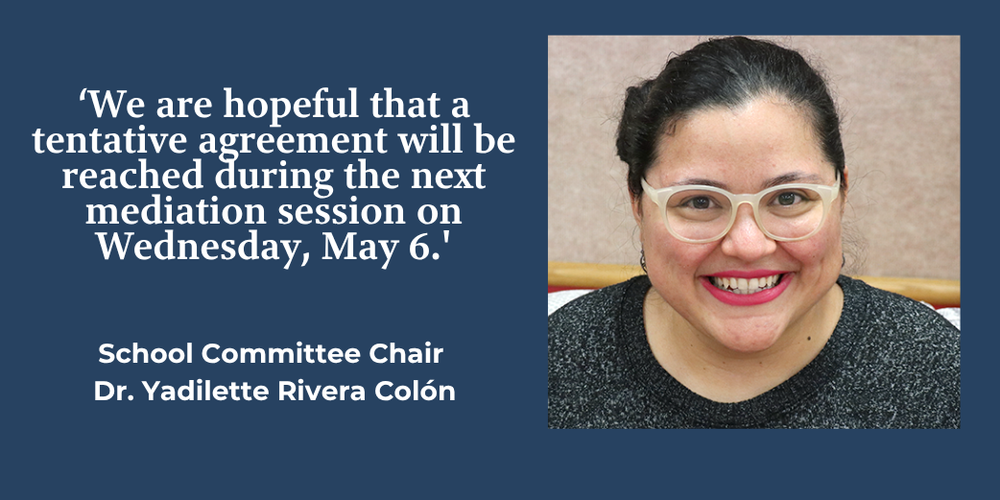
In her letter, Dr. Rivera-Colón provided detailed information about areas where the two bargaining teams have reached tentative agreements, as well as areas of divergence where additional work is needed to reach an agreement. “We are hopeful that a tentative agreement will be reached during the next mediation session on Wednesday, May 6,” she said.
Areas of tentative agreement include:
Work day and work year. The bargaining teams have agreed to a work year of 186 days (a two-day decrease), and no early release for students or extended professional development days for teachers on Wednesdays. The agreed-upon work day schedule eliminates after-school professional learning, so the teachers’ work day focuses on time with students and entry/dismissal duties. The elementary school student day also is reduced by 15 minutes to 6 hours and 30 minutes. The total hours reduction compared to the current schedule is 55 hours for middle school, 70 hours for high school, and 100 for elementary teachers. These reductions are in addition to the current pilot program, which already reduced the schedule for elementary and middle school teachers by 188 hours.
Protected planning time. The School Committee’s latest proposal includes protected prep periods every day, with the ability for administrators to reallocate up to two of those periods per month for common planning. The expired contract does not guarantee any protected prep periods, although the practice has been for teachers to have 3-4 protected prep periods per week. Common planning time allows educators to analyze student data, plan with curricula, and share best practices. The shared sense of purpose and collaboration enhances overall school culture as well.
Teacher voice. In response to proposals from the HTA, the proposal elevates teacher voice by establishing committees to help make important decisions. School-based decision making is expanded by establishing a Joint Oversight Committee to support school leaders with operational decisions such as allocations of discretionary funds, schedules and calendars, and class size/equitable caseloads. Health and safety standards are increased, including establishing a Health and Safety Committee. Additionally, catastrophic leave is decided by a team that includes up to two HPS administrators and two HTA members, with a majority vote of three people needed for approval.
Sick leave and catastrophic leave. There are many components of sick leave for which the two bargaining teams have reached agreement. Teachers’ sick days would be frontloaded on September 15 each year, instead of requiring that the time be accrued before using. The School Committee’s proposal provides an additional three days for personal time, which is separate from sick time. The maximum accumulation of sick days increases under the proposal to 150, up from 120 days. And, catastrophic leave would provide extended leave similar to a sick bank but funded by the district, not on time donated by members.
Grievance/arbitration. Under the proposal, grievances that cannot be settled through the informal process would have the option for arbitration, which is a final and binding decision—whereas the previous contract only provided the option for mediation, which is non-binding.
Areas of divergence where additional work is still needed include:
Overall compensation. The most recent district proposal includes more than a 20% aggregate increase on average over three years, representing an average increase of $12,500 per teacher and a $8.7 million investment in teachers’ salaries. This is an addition to the 19.6% increase received in the previous contract over three years.
The teachers compensation structure provides salary increases for a teacher's time in the district, education, and professional licensure, in addition to annual increases at every step and lane. Many adjustments have been made in response to the HTA’s feedback, such as increasing salaries at all levels, creating a more traditional step and education lane structure, creating a single compensation table for teachers and teacher leaders, and removing the advanced teacher column.
Salaries would range from $55,000 to $91,900 in the first year of the contract. The bachelors lane, step 1, starting salary of $55,000 would be higher than all nine comparison school districts. As an example, Holyoke would rank third among comparison districts for its masters lane, step 5 ($66,300). The district’s proposed professional licensure lane, top step ($91,900) is comparable to other districts’ masters lane. The proposed longevity payments of up to $4,000 and critical needs stipends ranging from $1,500 to $5,000 would be in addition to that salary. See this one-page overview of salary growth for a new teacher and visit the district website in the coming week for more examples and comparisons.
There has been some criticism about having a lane that recognizes teachers who have their professional license. Approximately 96% of teachers statewide are licensed, compared to 76% of teachers in Holyoke. When you include other members of the HTA who are not classroom teachers but who provide essential services to students, such as counselors and speech pathologists, it drops to 57%. Holyoke’s students deserve to have licensed teachers because licensing sets a professional standard for knowledge, skills, and experience, as seen in other professions. The district’s licensed teachers deserve to be recognized and financially rewarded for the effort and expense of becoming licensed. The HPS leadership team is committed to continuing to provide many opportunities and avenues to support teachers on their licensure journey.
Sick / Personal Leave. The School Committee’s proposal includes 13 days of combined sick/personal leave (10 sick days and 3 personal days), which is an increase from 10 sick/personal days in the expired contract. The HTA has proposed 14 sick days, plus 3 personal days, for a total of 17 days, which is greater than comparison districts. The School Committee’s proposal is in line with Springfield’s and two days less than other nearby districts. The rationale for this is that HPS wants to keep the teacher attendance rate high because students learn best when taught by their assigned teachers, and because other proposed protections in sick and catastrophic leave will provide time for teachers who need it.
Childbonding Leave. HPS recently proposed five paid days for childbonding for parents, in addition to other accrued sick, or personal time. Only one of the nine comparable districts offers any childbonding time at all. This is the first time that dedicated time for childbonding would be paid in Holyoke. The HTA is proposing 15 days.